Bugline Trail: North Lake to Sussex
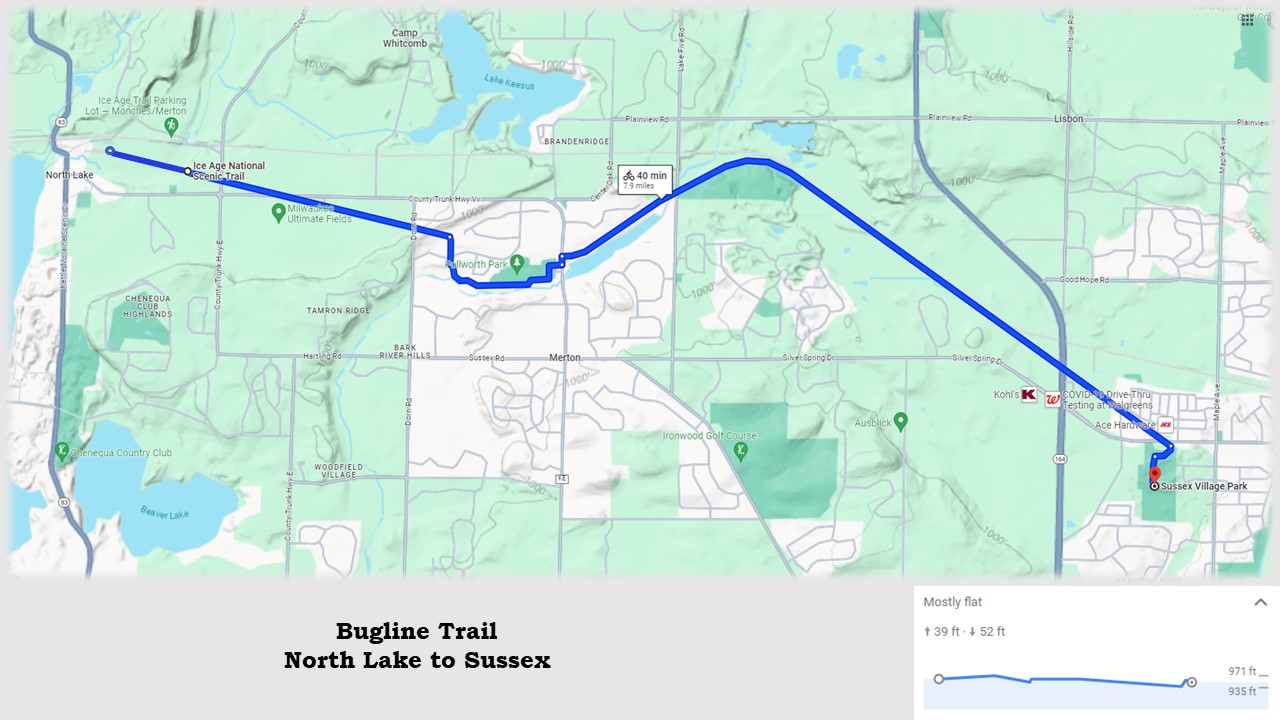
The 8.3 miles of the Bugline Trail from North Lake to Sussex offer beautiful views on a paved trail. Along the way, the path travels through hardwood forests, farm fields, and suburban neighborhoods. This segment of the trail crosses two rivers and passes four community parks. One tunnel cuts under a state highway, and there are wight other roads to cross.
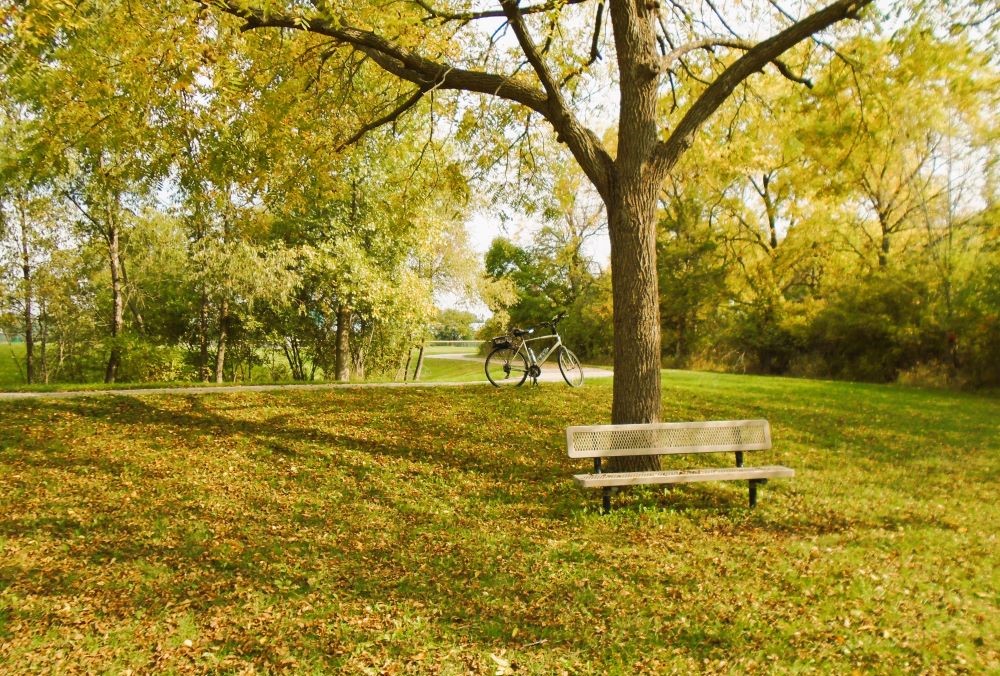
The ten-foot wide trail is paved with asphalt, and in excellent condition. The route from North Lake to Sussex is fairly level, with a slight descent. The path is well marked, with trail signs naming roads at each intersection. Trail rules are also posted at each road crossing. Mileage markers indicate distance, and park benches are generously placed along the way.
There is no trailhead at the path’s start near North Lake. On Hartman Court, a sign points to the trail’s start down a dirt road to the south. The road leads to the trail, then enters private property. “No trespassing” signs inform vehicles not to proceed into the property. As a result, this road serves only as a quick drop-off location, with no parking.
Parking is available nearby, permitted on the shoulder of Harman Court. Some trail-goers park on Hartman Court near the trail sign and dirt road entrance. Others park 350 yards east, where a driveway leads to a storage garage and provides trail access.
To reach the trailhead by vehicle, from Wisconsin State Highway 83 in North Lake, turn northeast on Kilbourne Road. Drive 0.3 mile and turn right (south) onto Hartman Court. The dirt road is 300 feet ahead. The second parking spot is another 350 yards down the road.


The Bugline Trail begins its eastward journey near the unincorporated community of North Lake. Located in northwestern Waukesha County, this area was once a crossroads of two Native American trails. This land was originally home to members of the Ho-Chunk and Potawatomi tribes, who lived on the shores of different local lakes.
The first white Americans arrived in the area in1837, when Wisconsin was still a territory. The first home was built in 1853, with mills appearing soon after. The lakes attracted visitors, and resorts were built for urbanites traveling here for leisure and recreation. As the population increased other businesses were constructed, including a general store, brewery, hotel, stockyards, and lumber company. Today, North Lake still caters to tourists.
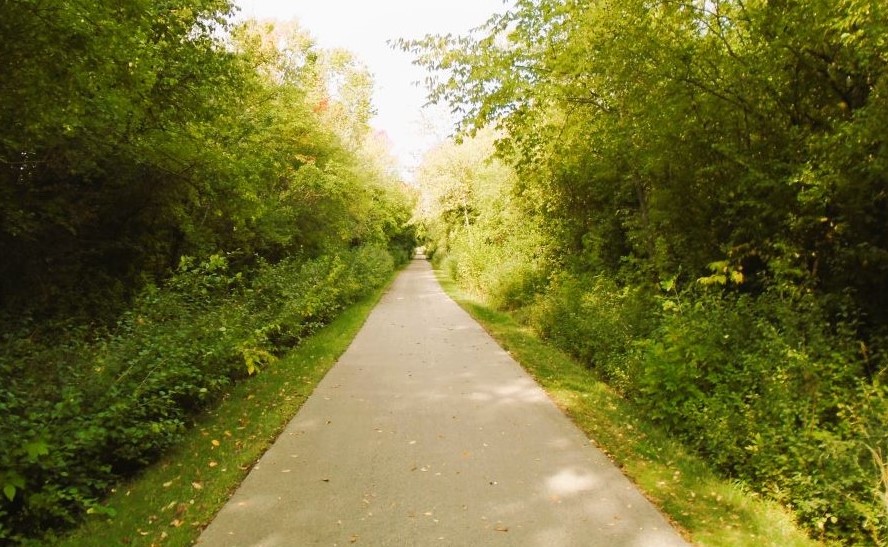
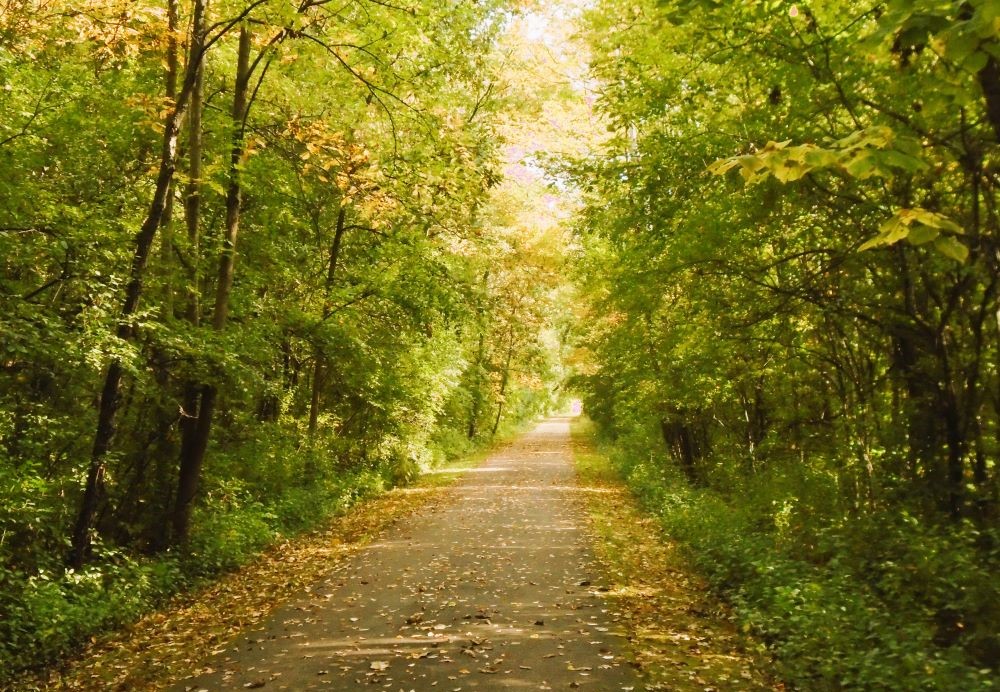
Returning to the Bugline Trail, it advances east from its begins through a hardwood forest. After a half mile, it bridges the small Oconomowoc River. On the river’s eastern bank, a hiking trail emerges from the left (north), winding down the hill and onto the path. This is the Ice Age National Scenic Trail, which shares the route for 1.5 miles. In some sections the Ice Age Trail has a separate grassy path, adjacent to the paved Bugline Trail.
After 0.75 mile the trail crosses its first road, County Highway E. Less than a half mile later it crosses County Highway VV. The trail intersects this county road several times along the way. On the south side of road is the expansive Milwaukee Ultimate Fields. The land previously housed the Milwaukee Polo Club, but now is claimed by Ultimate Frisbee Group.


From the County Highway VV, the Bugline Trail continues east past farm fields and residential neighborhoods. It crosses two streets, including Dorn Road. the Ice Age National Scenic Trail departs from the path at Dorn Road, following the road to the right (south).
About 350 yards east of Dorn Road, the trail turns sharply right (south). It is easy to assume the route continues straight east, but this is a spur trail leading to a nearby street. The main trail turns right (south) and heads down a short, steep hill through a neighborhood.
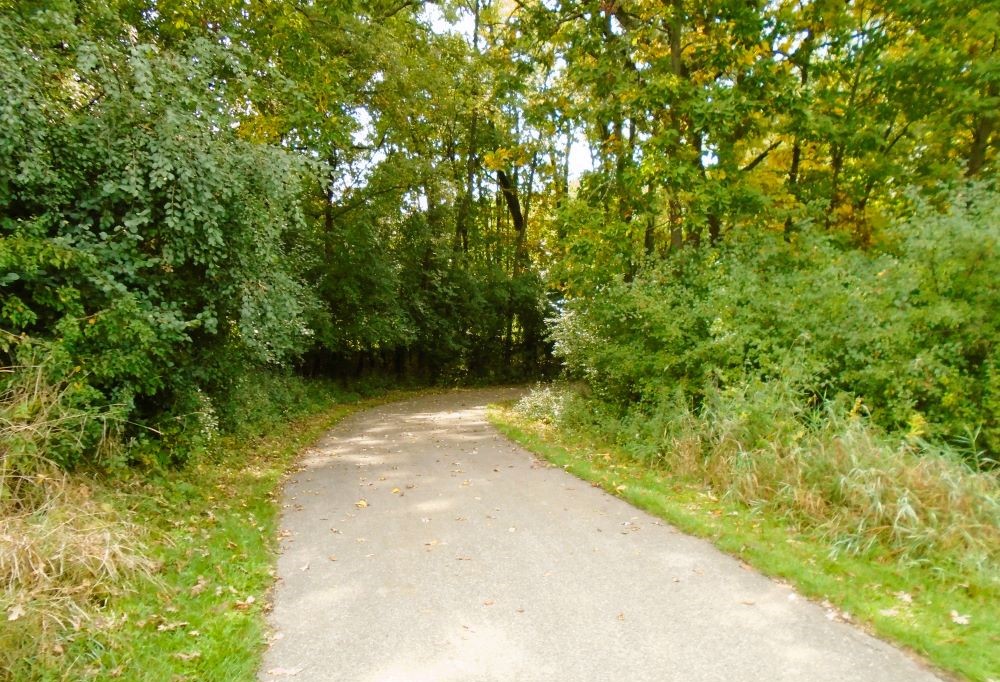
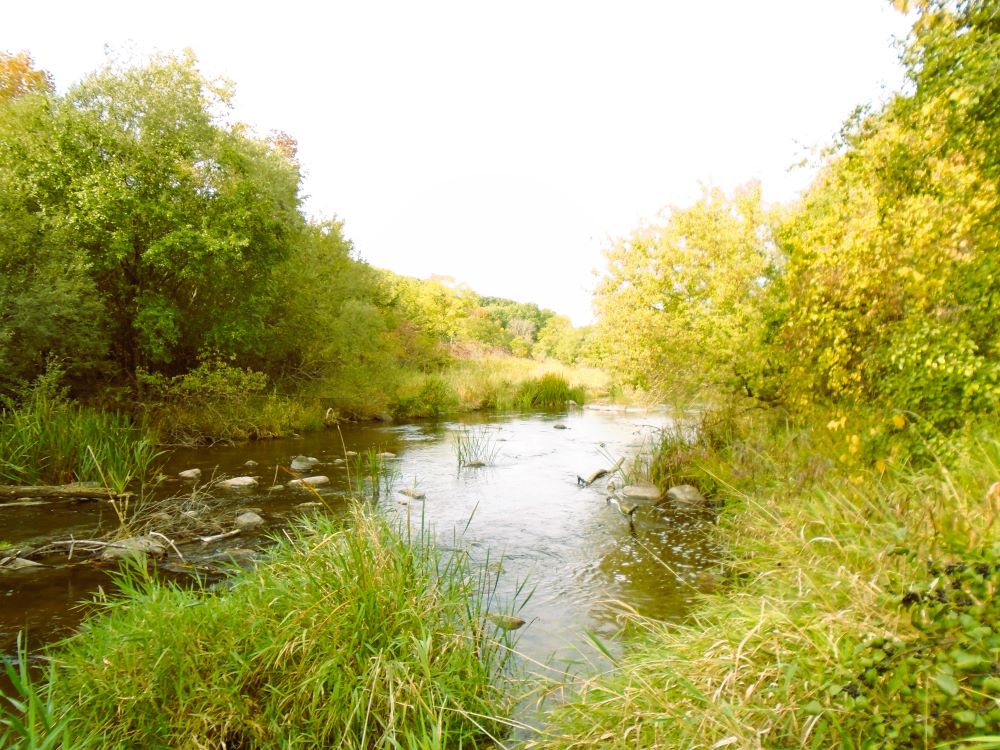
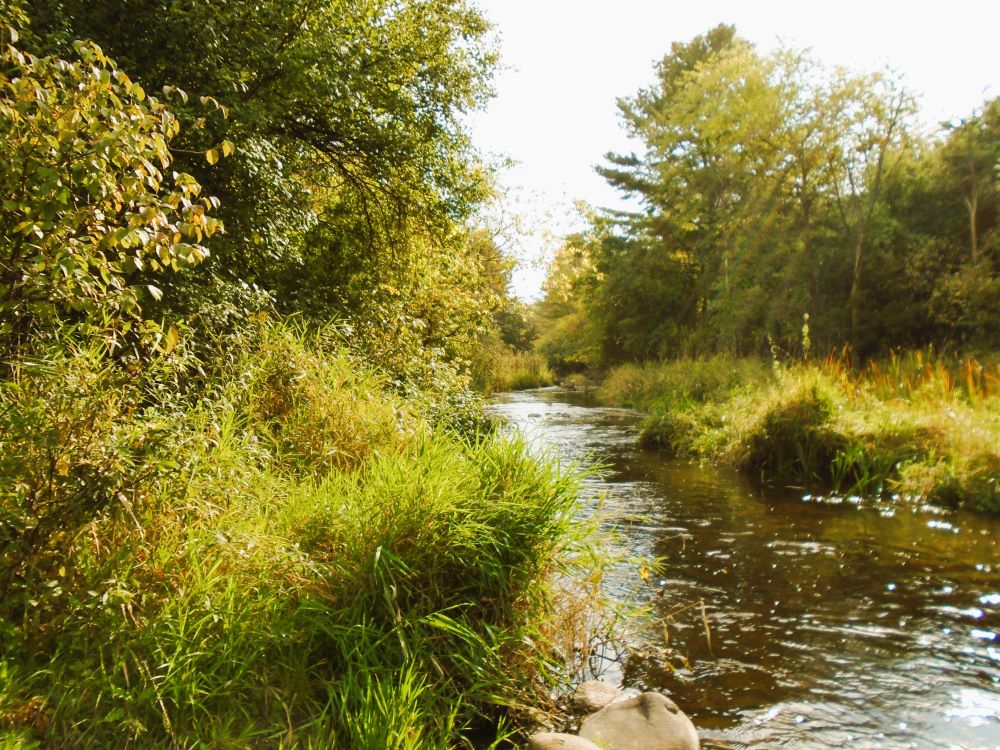
After crossing Bark River Drive, the trail enters a forest and turns left (east). This forest surrounds the picturesque Bark River. For well over a mile, the trail runs between the babbling river and two parks in Merton. Park benches beneath butternut trees overlook the attractive river, and it is worth taking a moment to enjoy the scenery.
Pollworth Park is the first park along the trail. It has a parking lot, ball diamonds, and restrooms open only on game days. Fireman’s Park comes next, with restrooms, picnic tables, a playground, and ball diamonds. A trailhead with parking lot is located aside the park. There are also park benches and a self-serve bicycle repair station. The trailhead and park is accessed by car from County Highway VV (Main Street) in Merton.
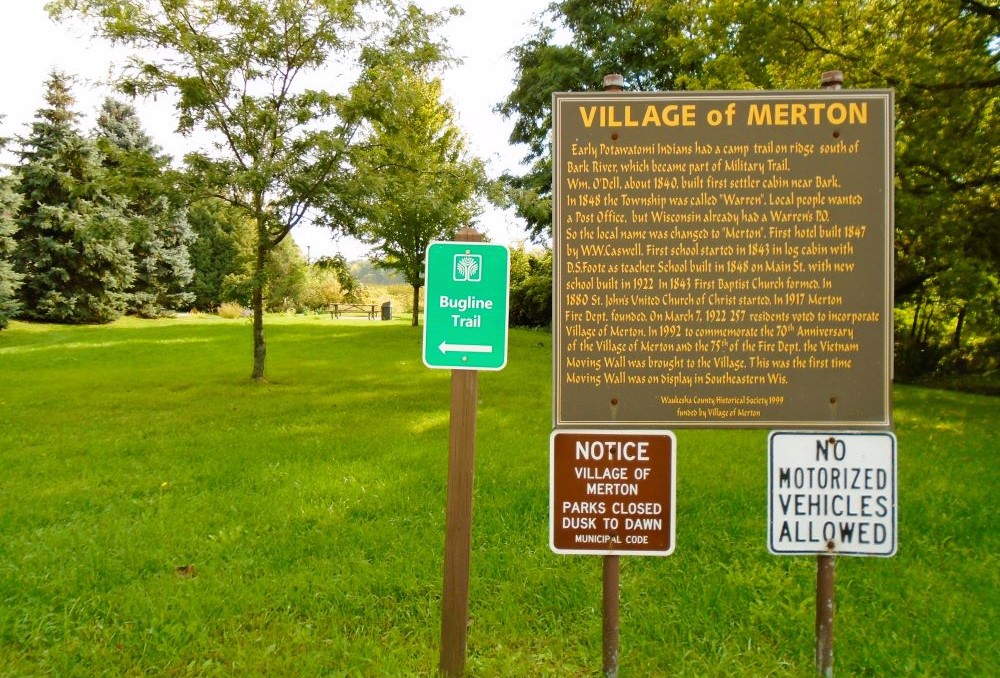
On Main Street, a historical marker tells the story of Merton. A Potawatomi village once sat on the Bark River nearby, along a Native American trail. White Americans and European immigrants began arriving in the 1840s. The community was named “Warren,” but changed its name to honor the English town of Merton. In 1922, the village was incorporated.
Nineteenth century life in Merton was centered downtown. With many of its original nineteenth century buildings still standing today, Merton’s Main Street imitates a typical New England village. A few of these historic structures house taverns and other places offering meals. A local favorite for lunch is Merton Sub Company.
Two Native American mounds in Merton were once referred to as “Fort Hill.” Increase Lapham surveyed the mounds in 1851. One mound was a large bird-shaped effigy. They were constructed by Native Americans from 700 BC-1300 AD, during the “Woodland Period. Most of the mounds groups were eventually destroyed by farming.
Returning to the Bugline Trail in Merton, the path crosses County Road VV (Main Street) and turns left (north). It travels one block on Main Street. Immediately after crossing Paul Avenue, the route turns right (east) and returns to the paved path.
The trail contines northeast. To the right (south) is Merton Millpond 26. It’s tough to see the pond due through the forest. Nearly a mile from Main Street, the trail crosses Bark River, which is surrounded by reeds and cattails. The Bugline Trail crosses Lake Five Road.
After crossing the Lake Five Road, the Bugline Trail passes another park. A spur trail on the right (south) leads to Lisbon Community Park. This park is a beautiful space that works well as a trailhead or rest top. It has many amenities including restrooms, picnic tables and grills, covered shelters, hiking trails, canoe access to the Bark River, fishing, and a volleyball court. The park’s archery range is a bit further down the trail.
Lisbon Community Park is reached by car from Wisconsin State Highway 164 in Sussex. From the state highway, turn west on Silver Spring Drive and drive 2.6 miles to Lake Five Road. Then turn right (north) and drive one mile. Turn right (east) on Oakwood Road, proceed 175 yards, and turn left (north) into the park on Bartlett Parkway.
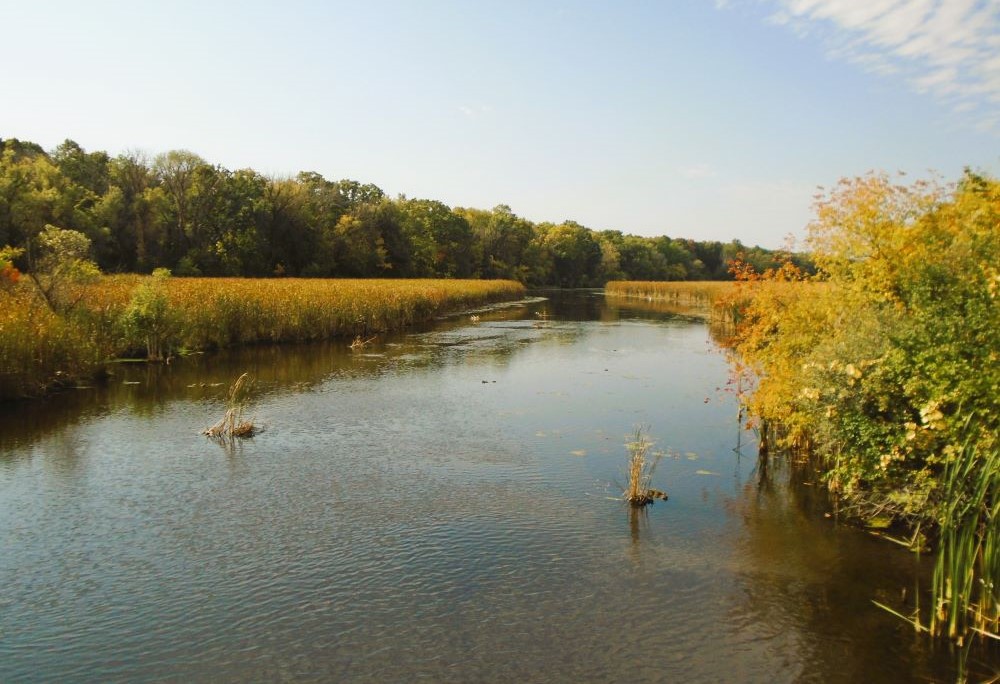
The Bugline Trail skirts Lisbon Community Park, bending for a mile around its northern boundary. Then the trail journeys southeast for three miles. Initially it runs through open marshland, dotted by small stands of trees. Vegetation still lines the trail in this section, where empty railroad cars line the tracks adjacent to the trail.
As the trail approaches the village of Sussex, marshlands give way to urbanization. A tunnel brings trail-goers under the four lanes of Wisconsin State Highway 164 and into the village. Continuing southeast, the path crosses Pewaukee Road. It next arrives at busy County Highway VV (Main Street), where flashing crosswalk lights may be deployed when crossing. On its south side, the trail passes Sussex Village Hall.
The main path heads down a hill, but trail-goers may take a spur trail to the right (south) up a small incline. This leads to Sussex Village Park, another trailhead. It is 0.3 mile to the parking lot. This substantial park features restrooms, picnic shelters, a playground, splashpad, multi-sport courts, athletic fields and ball diamond, and a disc golf course.
By car, the park is reached from County Highway VV (Main Street) in Sussex. Turn south onto Weaver Drive. After 0.3 mile, the entrance appears on the left (east) side of the road.
The village of Sussex was founded in 1843 by two Englishmen. George Elliott was a bricklayer from Beckley, East Sussex, and Richard Cooling was a blacksmith from Dorset. The settlement grew slowly. In the late 1800s, the advent of the railroad and quarrying of Lannon stone hastened development. Sussex was incorporated as a village in 1924.


Today, this charming Waukesha County village is a bedroom community for Milwaukee. Sussex has restaurants, coffeehouses, taverns, and cafés to serve its residents and visitors. Many of these establishments are on Main Street, near the bike path.
Immediately off the path, Loca Latte welcomes trail-goers. It specializes in gourmet coffee, sandwiches, salads, baked goods, and desserts. A main attraction is their large outdoor patio with central fire pit. Belfast Station Irish Pub & Grill is also located near the trail in Sussex, offering American and Irish pub fare. Both the fish and chips or Reuben sandwiches are highly recommended (a pint of Guinness is optional).
Map of trailheads and addresses along this section of the trail.
Parents looking for a family-friendly route may consider a ride on the Bugline Trail that links any of the three parks. Of note, the one-mile section from Fireman’s Park in Merton to Lisbon Community Park has two roads to cross. The four-mile section from Lisbon Community Park to Sussex Village Park has two road crossings.
As the Bugline Trail advances east from North Lake to Sussex, the landscape gradually changes from rural forests and farms to a more suburban environment. Nonetheless the scenery is pleasing, the incline slight, and the overall journey agreeable.
Trail last ridden and documented in September, 2023.